How Patchstack Is Devaluing Vulnerability Research
A researcher-side critique of Patchstack's shared bounty pool, duplicate risk, XP dilution, rejection penalties, leaderboard incentives, and the economics of vulnerability research.
How Patchstack Is Devaluing Vulnerability Research
You can find a Critical vulnerability, spend days reading source code, building a lab, engineering a reliable PoC, proving impact, and writing a clean report — and still end up with a payout that feels completely disconnected from the work.
Worse: you can do all of that correctly and still receive nothing because somebody else reported the same vulnerability first.
Patchstack markets an attractive package to WordPress security researchers:
- a minimum $10,000 monthly bounty pool;
- Zero-Day rewards advertised at up to $33,000;
- CVE credit;
- XP;
- leaderboards;
- researcher profiles;
- monthly competition.
On the surface, it looks like a strong place to hunt.
But once you stop looking at the headline numbers and start looking at the mechanics underneath them, the economics become much less attractive.
For standard monthly vulnerabilities, Patchstack is not simply assigning a fixed cash value to each accepted finding. Under the contribution-based model introduced in September 2026, researchers compete for a percentage of a shared bounty pool based on XP.
And before a finding even reaches that pool, it has to survive one of the oldest and most painful risks in bug bounty:
duplicate risk.
That creates a very different market.
You are no longer only competing against vulnerable code. You are competing against other researchers twice: first for uniqueness, then for a larger share of the pool.

Patchstack. Image used for commentary and analysis.
The old bargain was simple: find a bug, get paid for the bug
Traditional bug bounty economics are easy to understand.
1
2
3
4
5
6
7
Find a vulnerability
        ↓
Prove the impact
        ↓
Program evaluates the finding
        ↓
That vulnerability gets a bounty
A program might publish something like:
| Severity | Example bounty |
|---|---|
| Low | $100 |
| Medium | $500 |
| High | $2,000 |
| Critical | $5,000+ |
The exact numbers are not the point.
The important part is this:
The vulnerability itself is the unit being priced.
If a program receives ten additional valid findings, it incurs additional bounty cost for those ten findings.
If fifty new researchers join the program tomorrow, the bounty for your already-valid Critical does not automatically shrink simply because more people are now hunting.
You can inspect the payout table, estimate the impact, calculate your research cost, and decide whether the target is worth your time.
That is a relatively legible market.
Patchstack’s standard monthly model changes the unit of competition.
Before the pool even matters, duplicate risk can zero out the entire project
This risk deserves its own section because every serious bug bounty researcher knows how brutal it can be.
Patchstack’s rules require vulnerabilities to be new and unique. If multiple researchers report the same vulnerability, the first valid submission gets the credit; later submissions are rejected. Patchstack’s disclosure policy also states that duplicate reports are not eligible for rewards.
That means a technically excellent report can have this economic outcome:
1
2
3
4
5
6
7
8
9
10
11
12
13
20 hours of source review
        ↓
Real vulnerability found
        ↓
Reliable PoC built
        ↓
Impact proven
        ↓
Report written correctly
        ↓
Someone submitted it first
        ↓
$0
Nothing about the technical quality of the research necessarily changed.
The vulnerability was real.
The analysis was correct.
The exploit may have worked perfectly.
The researcher simply lost the race.
And the platform does not reimburse that research time because the work happened to overlap with another researcher’s work.
That is duplicate risk: the possibility that a correct research project has zero monetary value to the program because the underlying security asset is no longer unique.
This risk is not unique to Patchstack. It is one of the defining economic risks of bug bounty in general.
But in Patchstack’s current model it matters even more, because researchers face two layers of competition:
1
2
3
4
5
Layer 1: uniqueness race
Who reports the vulnerability first?

Layer 2: pool competition
How much XP do you own relative to everyone else?
So the real funnel is not:
1
Find bug → get XP → get paid
It is closer to:
1
2
3
4
5
6
7
8
9
10
11
12
13
14
15
16
17
Find bug
   ↓
Is it valid?
   ↓
Is it in scope?
   ↓
Is it unique?
   ↓
Did someone beat you to it?
   ↓
How much XP is it worth?
   ↓
How much total XP exists?
   ↓
What is your rejection adjustment?
   ↓
Final payout
That is a lot of uncertainty sitting on top of researcher-funded labor.
And duplicate risk has a particularly nasty asymmetry:
The researcher pays the full cost of discovering the vulnerability, while the market value can collapse to zero at submission time.
A realistic expected-value model therefore needs a uniqueness term:
1
2
3
4
5
6
7
EV
=
P(unique)
× P(valid | unique)
× Expected payout
-
Research cost
That P(unique) term is not academic.
On crowded WordPress targets, it can decide whether a week of technically successful research produces money or produces a duplicate notification.
Patchstack turned standard bounty hunting into a shared-pool economy
Patchstack now guarantees a minimum monthly pool of $10,000 and distributes it based on relative contribution.
Their own example is straightforward:
1
2
3
4
5
6
7
8
Total community XP: 2,000
Your XP: 400

Your contribution:
400 / 2,000 = 20%

Monthly pool: $10,000
Calculated bounty: $2,000
The simplified formula is:
1
2
3
4
5
Your payout
≈
Your XP / Total XP
×
Monthly bounty pool
At first glance, this feels fair.
Contribute more, earn more.
But there is one variable that changes everything:
1
Total XP
That is the denominator.
And that denominator is produced by everybody else.
Which means the cash value of one XP is not fixed.
If we hold the pool at $10,000 purely for illustration:
1
2
3
4
5
6
Total XP      Implied value per XP
----------------------------------
2,000 XP      ~$5.00
5,000 XP      ~$2.00
10,000 XP     ~$1.00
20,000 XP     ~$0.50
This is not a prediction of actual payouts. The final pool can exceed the minimum and other rules affect compensation.
But the economic mechanism is unavoidable:
If total XP grows faster than the bounty pool, the implied monetary value of each XP falls.
That is the hidden variable behind the attractive “$10,000 monthly pool” headline.
Researchers should care about the denominator just as much as the numerator.
More researchers can mean more intelligence for Patchstack — and thinner economics for researchers
This is where the model becomes especially attractive for the platform.
In a per-finding system:
1
2
3
More valid vulnerabilities
        ↓
More bounty liability for the program
In a proportional shared-pool system:
1
2
3
4
5
6
7
More valid vulnerabilities
        ↓
More XP
        ↓
Larger denominator
        ↓
Researchers compete for relative share
Patchstack can attract more hunters, receive more reports, grow its vulnerability database, increase CVE coverage, and collect more security intelligence.
But the compensation budget does not necessarily need to scale linearly with the amount of research being produced.
From a buyer’s perspective, that is extremely efficient:
1
2
3
4
More supply
+ more competition
+ more intelligence
+ relatively predictable acquisition cost
From a researcher’s perspective, the result can be the opposite:
Researchers can end up competing with each other to reduce the implied price of the very research they are producing.
And duplicate risk makes that competition even harsher: some researchers are not merely diluted — they are eliminated from compensation entirely because somebody else arrived first.
That is not a small detail.
That is the economic center of the model.
The leaderboard is not just decoration. It is a production engine.
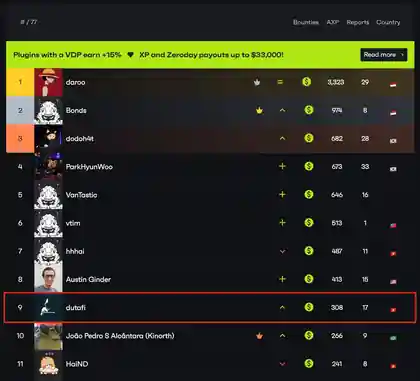
Leaderboard snapshot used to illustrate rank, XP, report count, and competition mechanics. Rankings change over time.
Leaderboards are addictive for a reason.
Someone has 29 reports.
Someone else has 33.
Another researcher has 2.
The obvious reaction is:
“I need to hunt more.”
That is gamification doing exactly what gamification is designed to do.
Rank. XP. Report counts. Movement up and down. Country flags. Monthly competition.
All of it turns vulnerability research into a visible game of production.
And that is incredibly useful to a marketplace that wants more supply.
The platform gets:
1
2
3
4
5
6
7
More hunting
   ↓
More reports
   ↓
More XP
   ↓
More vulnerability intelligence
But if the pool does not increase at the same speed:
1
2
3
More XP
   ↓
Lower implied value per XP
That is the contradiction.
The leaderboard psychologically rewards production while the shared pool economically rewards relative scarcity.
Those incentives are not perfectly aligned.
Researchers can end up racing each other to the bottom
No researcher is deliberately trying to undercut another researcher.
Everyone is simply responding rationally to the system:
“I need more XP if I want a larger payout.”
But when everyone optimizes the same metric, the collective outcome can become ugly.
1
2
3
4
5
6
7
8
Researcher A produces more
Researcher B produces more
Researcher C produces more
Researcher D produces more
        ↓
Total XP increases
        ↓
Competition for each percentage point increases
This is why I describe the dynamic as a race to the bottom.
Patchstack does not need to send an email saying:
“Your vulnerability is worth less this month.”
It does not have to.
A shared denominator can do that automatically.
The market mechanism performs the discounting.
And duplicate risk makes the race literal: being second can mean the monetary value of the research drops from potentially meaningful to zero.
A Critical vulnerability no longer guarantees Critical money
This is another place where researchers can misread the economics.
A vulnerability can have a Critical CVSS score and still produce a surprisingly modest economic result.
Patchstack does not simply map CVSS directly to cash. XP can be influenced by factors such as install count, required privilege, vulnerability class, user interaction, attack complexity, POP-chain requirements, and other program rules.
Then that XP still enters the shared pool.
Economically, the pipeline looks more like this:
1
2
3
4
5
6
7
8
9
10
11
12
13
14
15
16
17
Technical severity
      ↓
CVSS
      ↓
Install / privilege / bug-class multipliers
      ↓
Conditions and penalties
      ↓
Uniqueness requirement
      ↓
XP
      ↓
Community denominator
      ↓
Rejection adjustment
      ↓
Final payout
There is nothing inherently wrong with bounty pricing using signals beyond CVSS. CVSS was never designed to be a researcher compensation system.
But the consequence matters:
Technical severity and economic value are now two different systems.
A vulnerability can be dangerous to users and still be economically cheap to the person who discovered it.
Or economically worthless to the second researcher who independently discovered the exact same bug.
This is where valuable research starts getting sold too cheaply
Consider a moderately difficult finding.
A researcher spends:
1
2
3
4
5
6
7
4 hours reading source
3 hours tracing logic
2 hours building the lab
4 hours engineering the PoC
3 hours debugging
2 hours building negative controls
2 hours writing the report
Total:
1
20 hours
If the eventual economic return is:
1
$100
the effective rate is:
1
$100 / 20h = $5/hour
And if it turns out to be a duplicate:
1
$0 / 20h = $0/hour
The vulnerability can still be technically correct.
That number is only an example for opportunity-cost analysis. It is not a claim that Patchstack pays $100 for every finding of this kind.
But the principle is obvious: XP animation, CVE credit, and leaderboard rank do not change the effective hourly economics.
Security research is not mechanical data entry.
A capable vulnerability researcher may be doing:
- source-code auditing;
- threat modeling;
- authorization analysis;
- exploitability analysis;
- debugging;
- PoC engineering;
- version validation;
- negative-control testing;
- technical writing.
That is skilled technical labor.
CVEs look great on a profile. They still do not pay the bills.
CVE credit has real value.
It builds credibility.
It strengthens a portfolio.
It can help a career.
But reputation value should not be confused with cash compensation.
CVE credit does not pay rent.
Leaderboard rank does not pay the electricity bill.
XP does not pay for AI or API subscriptions.
Researcher badges do not pay for lab infrastructure.
A two-hour bug that pays modestly and gives useful CVE credit can be a good trade.
A two-week research project that produces the same reward is an entirely different deal.
A two-week project that comes back duplicate is worse again.
Rejection penalties change the game from bug hunting into portfolio management
In a simple bounty model:
1
2
Valid report   → paid
Invalid report → $0
Patchstack’s rejection mechanics can go further because rejection rate can reduce monthly compensation and can trigger additional consequences under the program rules.
That means a weak candidate does not merely have zero expected payout.
It can create downside for work that was already accepted.
Imagine this portfolio:
1
2
Report A → valid
Report B → rejected
Report B does not just fail to earn money.
It can reduce the economic value of Report A through the monthly rejection rate.
That is a major change in incentives.
The next submission is no longer only a bet on itself.
It is a bet against the entire monthly portfolio.
Duplicate risk is different from false-positive risk, but both belong in the same economic calculation: a technically expensive candidate can still produce zero direct return.
Patchstack has effectively pushed part of the QA burden onto researchers
Any platform wants fewer false positives.
Nobody benefits from low-quality AI-generated noise, non-reproducible claims, or reports that collapse under basic validation.
But the economic effect of rejection penalties is clear.
Researchers are incentivized to spend more time before submission on:
- local reproduction;
- negative controls;
- scope review;
- version checks;
- exploitability validation;
- false-positive elimination;
- conservative report selection.
That produces cleaner reports.
Which reduces triage pressure for Patchstack.
The researcher performs more quality control before the platform ever sees the finding.
From a business perspective, that is smart.
From a researcher perspective, it means more unpaid labor is required before the asset even enters the market.
I call that QA cost externalization.
That is not a claim about Patchstack’s internal motives.
It is simply what the incentive structure encourages.
Your competitors can improve their position simply by arriving first
There are two different competitive effects here.
First, relative contribution means one researcher’s XP affects everybody else’s share of the pool.
Second, uniqueness means one researcher’s valid submission can erase the direct monetary value of another researcher’s independent work on the same vulnerability.
That is a harsh market.
The second researcher may have done everything right.
They were simply second.
The system therefore creates tournament economics where timing, secrecy, target crowding, and submission speed become economic variables alongside technical skill.
Researchers are not only collaborating with the defensive ecosystem.
They are also competing against one another for uniqueness and economic weight.
The $33,000 Zero-Day headline is real — but the word “up to” matters
This is probably the most powerful number in Patchstack’s marketing:
ZERO-DAY PAYOUT UP TO $33,000
But the maximum advertised payout is not the same thing as expected value.
The qualifying path is narrow.
The Zero-Day lane has strict conditions around compromise impact, exploit reliability, prerequisites, configuration, user interaction, affected version, additional vulnerabilities, and POP chains.
And uniqueness still matters.
The practical funnel looks something like:
1
2
3
4
5
6
7
8
9
10
11
12
13
14
15
16
17
18
19
20
21
Critical?
   ↓
Unique / first valid report?
   ↓
Full-site compromise?
   ↓
Working exploit?
   ↓
No prerequisite?
   ↓
Default configuration?
   ↓
Latest stable version?
   ↓
No additional vulnerability required?
   ↓
No extra user interaction?
   ↓
Accepted POP-chain conditions?
   ↓
Zero-Day lane
Miss one important condition and the economics can change dramatically.
That is why:
1
UP TO $33,000
should be understood as a ceiling, not a likely market price.
Maximum payout is a ceiling. Expected payout is economics.
Patchstack does not just receive bugs. It receives raw material for a security business.
Patchstack is a commercial security company.
Vulnerability research can feed valuable downstream assets such as:
- vulnerability database coverage;
- security advisories;
- CVE intelligence;
- mitigation knowledge;
- threat intelligence;
- API products;
- hosting and security integrations;
- enterprise security services.
A vulnerability report does not disappear after triage.
It becomes knowledge.
1
2
3
4
5
6
7
8
9
10
11
12
13
Independent researcher
        ↓
Original vulnerability
        ↓
Validation
        ↓
Database / advisory
        ↓
CVE / intelligence
        ↓
Mitigation knowledge
        ↓
Commercial security value
There is nothing wrong with Patchstack building a business from security intelligence.
But the supplier-side question is still valid:
How much is the researcher being paid for the raw material that helps create that downstream value?
That is basic supplier economics.
“$10,000 monthly” sounds huge until you look at the denominator
Show the numerator.
Make it large.
$10,000 MONTHLY POOL
That sounds impressive.
Now ask the questions that actually determine expected return:
1
2
3
4
5
6
7
How many researchers are competing?
How many reports are being submitted?
How much total XP is being created?
How much effective XP exists after penalties?
How large will the final pool actually be?
What percentage of it does one researcher own?
What is the duplicate probability on the target?
Suddenly the headline looks very different.
If 80 researchers were splitting $10,000 equally, the simple average would be:
1
$125
That is not how the real distribution works, and it is not a payout prediction.
It is simply a useful reminder:
A large pool is not the same thing as a large individual expected value.
Marketing loves the numerator.
Researchers need to study the denominator — and the probability that their finding reaches the denominator at all.
If XP behaves like currency, researchers should be able to see its price
If XP determines economic share, then the dashboard should expose the market clearly.
Something like:
1
2
3
4
5
6
My XP: 308
Total effective XP: 6,420
Current share: 4.80%
Current pool: $10,000+
Estimated payout: ~$480 before adjustments
Current implied payout / XP: ...
That would be real transparency.
No reverse engineering.
No guessing.
No waiting until the end of the month to discover what the labor was worth.
The platform cannot reveal undisclosed reports just to eliminate duplicate risk — that would create obvious security problems — but researchers should at least be given the clearest possible economic information about the variables Patchstack can expose.
If researchers are supplying assets into a marketplace, they deserve basic price discovery.
Money mechanics should be easier to understand than exploit mechanics.
The pricing system is becoming a mini CTF of its own
Patchstack researchers now have to think about:
1
2
3
4
5
6
7
8
9
10
11
12
13
14
15
16
17
Scope
Uniqueness / duplicate risk
CVSS
Install count
Required privilege
Vulnerability class
User interaction
Attack complexity
POP chains
XP
Rejection rate
Leaderboard position
Monthly contribution
Zero-Day eligibility
Exceptions
Disclosure rules
Payout thresholds
There can be a valid reason for every individual rule.
But taken together, the compensation model becomes difficult to price before submission.
That is a problem.
Researchers should spend their cognitive energy reverse engineering vulnerable software — not reverse engineering the compensation engine that buys the result.
Why I call this “vulnerability sweatshop economics”
I use this phrase as an economic metaphor, not as a legal allegation.
Independent researchers pay for nearly all production inputs themselves:
1
2
3
4
5
6
7
8
9
10
Hardware
Electricity
AI / API subscriptions
Testing environments
Premium plugins
Research time
Duplicate risk
False-positive risk
Rejection risk
Opportunity cost
Then dozens of independent suppliers produce vulnerability intelligence.
The output is aggregated, standardized, validated, turned into advisories and database records, and ultimately contributes to commercial security intelligence.
Meanwhile, standard compensation is distributed through a shared pool.
From the aggregator’s side, that is extremely efficient:
1
2
3
4
5
Distributed production cost
+ competitive suppliers
+ strong quality incentives
+ predictable acquisition economics
+ growing vulnerability intelligence
From the researcher’s side, it looks very different.
The person creating the scarce technical asset carries most of the cost and most of the risk — including the possibility that the asset is already owned by the marketplace because somebody else reported it first.
That is why the model can reasonably be described as exploitative from the researcher’s economic perspective: the platform gets predictable acquisition economics while independent researchers absorb much of the discovery cost, duplicate risk, QA burden, and rejection downside.
Conclusion
Patchstack has built an efficient, cost-controlled vulnerability acquisition marketplace.
Researchers fund discovery, carry duplicate and validation risk, compete for a shared pool, and absorb rejection downside. Patchstack gets scalable vulnerability intelligence and predictable acquisition economics.
XP, leaderboards, CVE credit, and an “up to $33,000” headline make the system look exciting. They do not change that cost-and-risk allocation.
That is the criticism: Patchstack has optimized vulnerability acquisition for the platform, while much of the economic risk remains with the researcher.
References
- Patchstack Bug Bounty Guidelines & Rules
- Patchstack Bug Bounty Leaderboard
- The Future of the Patchstack Bug Bounty Program
- Patchstack Vulnerability Disclosure Policy
- Patchstack Pricing
Author’s note
This article is written from the perspective of an independent security researcher and intentionally focuses on researcher-side incentives and compensation economics. Terms such as “race to the bottom,” “QA cost externalization,” “exploitative,” and “vulnerability sweatshop economics” are analytical descriptions of incentive structures, not allegations of illegal conduct or claims about Patchstack’s internal motives.